We are digital piano & keyboard specialists, based in Banbury, Oxfordshire. Stay up to date with the latest
news, reviews, tips, and offers by joining our FREE newsletter (unsubscribe at any time).
The Yamaha CLP-885 and CSP-295 are standout models from the Yamaha Clavinova range.
I chose to review and compare these two models because, at first glance, their names might not convey the significant differences between them.
My goal is to make these distinctions clear, so you can make an informed decision.
> In the video below, I compare the CLP-785 (CLP-885’s predecessor) to the CSP-295. Most of the points I make remain relevant when comparing CLP-885 & CSP-295).
Design and Build
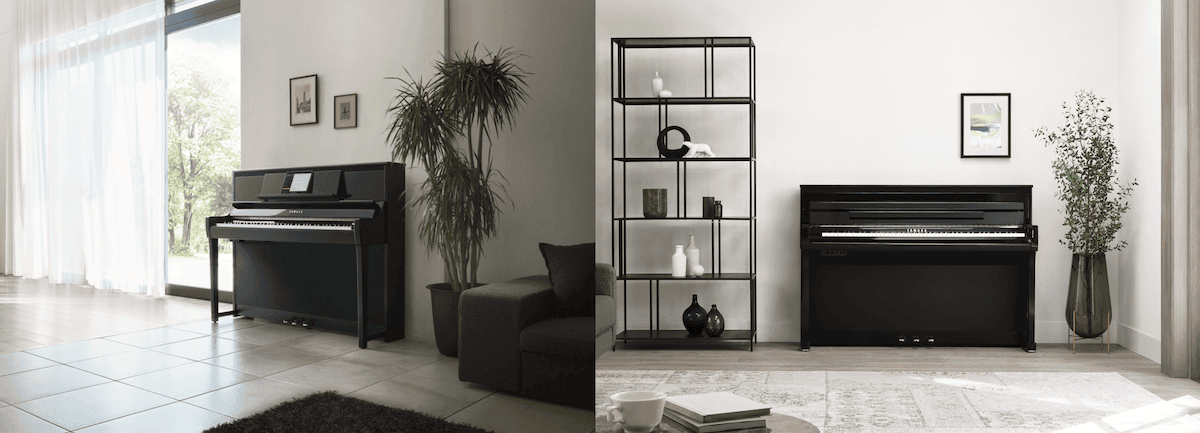
Both the Yamaha CLP-885 and CSP-295 feature a classic upright design, reminiscent of the renowned Yamaha U series.
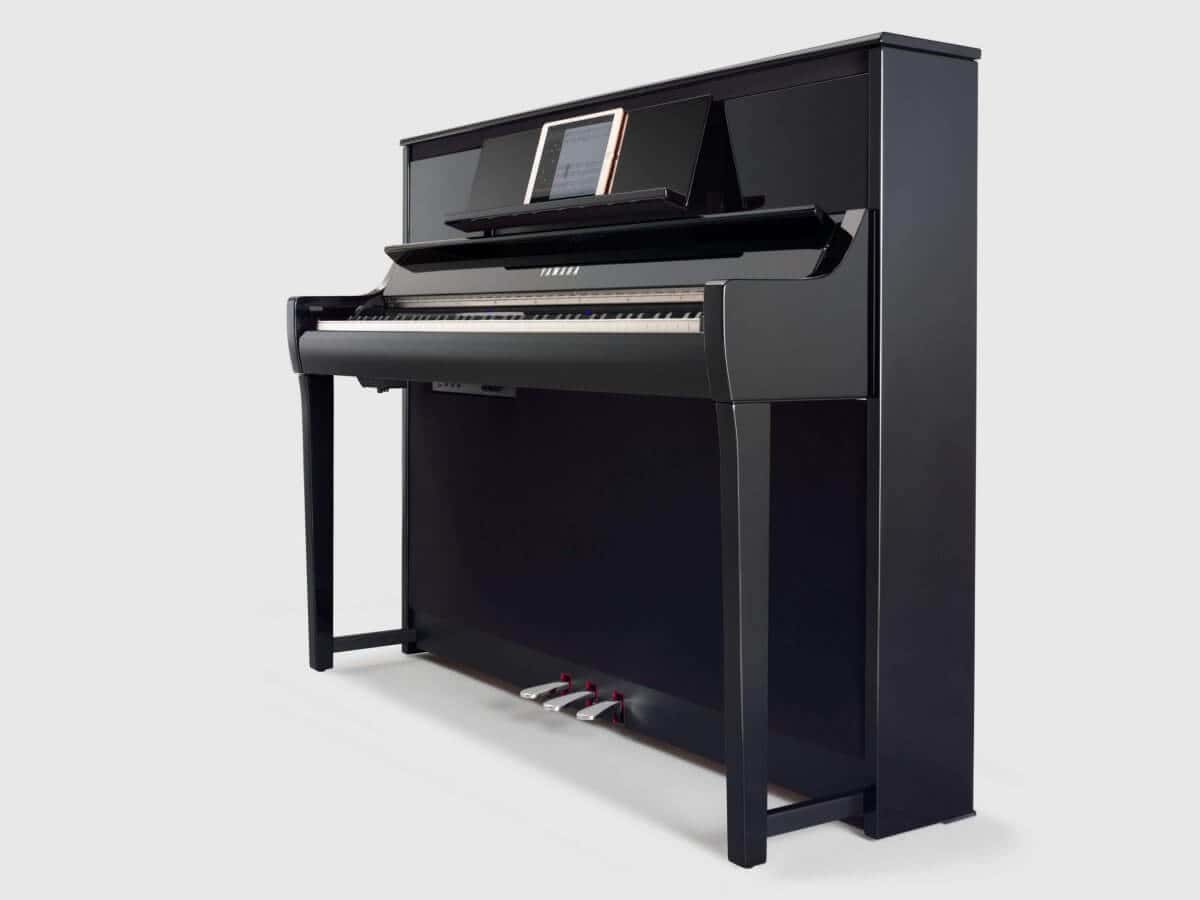
However, the CSP-295 stands out with a larger music rest, perfect for housing tablets like the iPad Pro, which is integral for using the Smart Pianist app.
Additionally, both models have a soft-close lid for a premium feel.
The first thing that struck me about these models was their sheer fidelity and premium quality.
After spending time with lower models in the range, returning to the CLP-885 and CSP-295 always reminds me of the depth and color these pianos offer.
They look and feel like real premium furniture pieces even before you lift the lid.
Yamaha CLP-885 (left), CSP-295 (right).
Dimensions and Weight
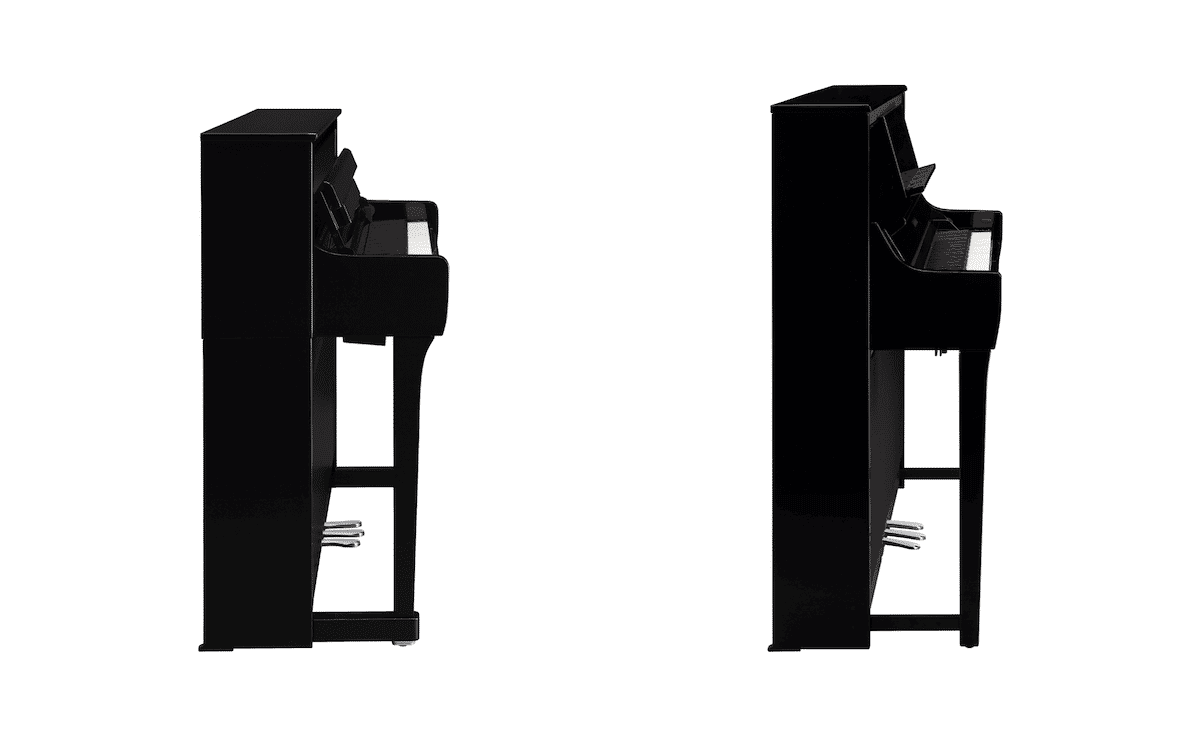
In terms of size, the two models are nearly identical in width and depth.
However, the CSP-295 is 10cm taller and 12kg heavier giving it slightly more substantial presence.
Despite the additional weight, both models maintain a sleek and elegant appearance, seamlessly fitting into any home décor.
Keyboard and Touch
Both the CLP-885 and CSP-295 come with Yamaha’s GrandTouch™ keyboard, featuring 88 keys and wooden white keys.
This advanced digital piano key mechanism ensures each key is weighted uniquely, providing a highly realistic playing experience.
They also include the GP Response Damper Pedal for precise control, making them ideal for advanced pieces.
Playing slow classical and jazz pieces on these models is a magical experience.
The resonance and the music that happen between the notes allow me to connect emotionally with the piano.
It’s as if these pianos understand and respond to my feelings, making every touch and brush of the keys a true expression of my emotions.
Yamaha CLP-885 in polished ebony
Sound and Tone Generation
These models boast Yamaha’s top-tier tone generation systems:
Binaural Sampling: Creates a realistic 3D sound experience with headphones.
Key-off Samples: Captures the subtle sounds of keys and hammers for greater realism.
Smooth Release: Mimics the damper’s varying speeds when keys are released.
Virtual Resonance Modeling (VRM) & Grand Expression Modeling: Replicates the intricate interactions of string and soundboard resonance, offering a rich, nuanced sound.
Both pianos offer 256-note polyphony, ensuring no note is cut off during complex pieces.
The sound quality is so rich and detailed that even the subtlest nuances of your performance are faithfully reproduced, making these pianos suitable for both practice and performance settings.
Voice Selection and Accompaniment
One major difference lies in their voice selection and accompaniment options.
The CLP-885 features 53 voices, while the CSP-295 boasts a staggering 872 voices.
Additionally, the CSP-295 offers 525 accompaniment styles compared to the 20 rhythms available on the CLP-885.
This extensive variety allows for a more dynamic and engaging playing experience on the CSP-295.
Having such a wide range of voices and styles means you can experiment with different genres and musical settings, making your practice sessions more enjoyable and varied.
Whether you’re in the mood for classical piano, jazz, rock, or something entirely different, the CSP-295 has you covered.
Yamaha CSP-295 in polished ebony
Control and Connectivity
The CLP-885 features a sleek touch panel that disappears when not in use, maintaining a clean, traditional look.
Both models can be controlled via the Yamaha Smart Pianist app, but the CSP-295 takes full advantage of this technology.
When paired with the app, the CSP-295 reveals a multitude of additional features, enhancing its versatility.
In my experience, the Stream Lights LED learning system on the CSP-295 is a game-changer, especially for beginners.
I’ve witnessed complete novices in my showroom light up with joy as they select their favorite song on the iPad and follow along with the LED lights.
The simplicity and visual aid of the Stream Lights system make learning accessible and fun, turning skeptics into enthusiastic musicians.
Learning Features
The CSP-295 excels in its learning capabilities, thanks to the Stream Lights LED learning system.
This innovative feature uses LED lights above the keys to indicate which notes to play and which notes are coming next. It’s a fantastic tool for beginners, making learning more intuitive and fun.
The Smart Pianist app offers over 400 preset songs and access to your device’s music library, providing endless learning opportunities.
For beginners, the CSP-295 is an incredible tool because it eliminates the artificial ceiling that many instruments impose.
These pianos grow with you, helping young players learn to express themselves with the dynamic range and sonic soundscape they offer.
Advanced players will appreciate how these pianos faithfully replicate the experience of playing a traditional piano, allowing for nuanced expression and emotional depth in their performances.
Yamaha CLP-885 (left), CSP-295 (right).
Performance and Versatility
One of the standout features of both models is their ability to deliver a performance that rivals acoustic pianos.
The Yamaha CFX and Bösendorfer Imperial piano samples provide an authentic playing experience, capturing the unique characteristics of these world-class instruments.
Whether you’re performing a delicate Chopin nocturne or a powerful Rachmaninoff concerto, these pianos will meet your demands.
For those who enjoy experimenting with different sounds, the CSP-295’s extensive voice library and accompaniment styles are a treasure trove.
You can easily switch between a grand piano and a jazz organ, or add a string quartet to your performance with just a few taps on the Smart Pianist app.
This versatility makes the CSP-295 an excellent choice for musicians who like to explore various musical genres and styles.
Integration with Technology
The integration of modern technology is where the CSP-295 truly shines.
The Smart Pianist app not only provides intuitive control over the piano’s functions but also opens up a world of possibilities for learning and creativity.
You can access a vast library of sheet music, play along with backing tracks, and even create your own music using the app’s recording features.
The Stream Lights LED learning system is particularly beneficial for those who are new to playing the piano.
This feature provides real-time feedback, guiding you through each piece and helping you develop your skills at your own pace.
It’s a great way to keep practice sessions engaging and fun, especially for younger players who might be easily discouraged by traditional learning methods.
> In the video below, I demonstrate the Yamaha CSP-295 and talk about why it’s the best blend of tech & tradition that I’ve ever seen on a digital piano.
Personal Experiences and Recommendations
Reflecting on my experiences with the Yamaha CLP-885 and CSP-295, it’s clear that both models have their unique strengths.
The CLP-885, with its traditional design and high-quality sound, is perfect for purists who want a digital piano that closely resembles an acoustic instrument.
Its minimalist interface and focus on core piano features make it a joy to play for those who prefer a straightforward, no-nonsense approach to music.
On the other hand, the CSP-295 offers a blend of tradition and innovation that’s hard to beat.
The combination of advanced features like the Stream Lights system, extensive voice library, and Smart Pianist app integration makes it an incredibly versatile instrument.
It’s particularly well-suited for those who enjoy using technology to enhance their learning and playing experience.
For beginners, the CSP-295 provides an unparalleled learning platform.
The Stream Lights system makes it easy to start playing right away, and the Smart Pianist app offers plenty of resources to keep you motivated and progressing.
Advanced players will appreciate the CSP-295’s wide range of voices and styles, allowing for greater creative expression and experimentation.
Practical Considerations
When deciding between the Yamaha CLP-885 and CSP-295, it’s important to consider your personal preferences and how you plan to use the piano.
If you value a traditional piano experience and prefer a more straightforward interface, the CLP-885 might be the better choice.
Its elegant design and high-quality sound make it a standout option for those who prioritise authenticity and simplicity.
If you’re looking for a piano that offers more features and flexibility, the CSP-295 is an excellent option.
Its integration with modern technology, extensive voice library, and innovative learning tools make it a highly versatile instrument.
Whether you’re a beginner looking to learn quickly or an advanced player seeking new creative possibilities, the CSP-295 has something to offer.
The Yamaha Smart Pianist companion app (compatible with CLP-885 & CSP-295) is free for Apple & Android devices.
Conclusion
In summary, while both the Yamaha CLP-885 and CSP-295 offer exceptional quality, they cater to different needs.
The CLP-885 is perfect for those who want a high-quality digital piano with a traditional feel.
In contrast, the CSP-295 is ideal for those who seek a blend of tradition and modern technology, with extensive learning features and a vast array of voices and accompaniments.
If you prefer traditional learning methods, the CLP-885 might be the better choice for you.
However, if you enjoy integrating technology into your practice and learning through innovative tools like the Stream Lights system, the CSP-295 is the way to go.
Both models are available to order from our website.
If you have any questions or need further assistance, feel free to contact us.
Thank you for reading our comprehensive comparison of the Yamaha CLP-885 vs CSP-295!
Sign up to our Newsletter
Enter your email address below to receive our free weekly newsletter containing the latest piano,
keyboard and organ demonstration videos, breaking news, special offers, invitations to our live video
events, technical support articles and much more.
Chris Hammond
Manager at ePianos
Chris handles all of our ePianos marketing, and is responsible for the creation and production of the majority of our product videos.
Chris is also one of our top blog writers, having extensive knowledge of keyboard instruments, years of experience in musical instrument retail, and a background in live performance and composition.
This and other videos by Chris have been influential in me trading in my csp170 for the csp295 . This is yet to arrive and the closest I have got to playing one was the equivalent Roland.
However in the meantime I replaced my gigging rd88 Roland with the CK 88 Yamaha. This has been a revelation!
Always in the past earlier Yamaha keyboards disappeared into the mix with a live band. The CK 88 is clear in the band and the piano is full and clear.The keyboard is also perfectly matched with the Yamaha dxr 12 amp.
I can only hope the csp 295 represents a real stepwise advance over the csp 170 . The csp 170 is a great digital system and although not up to my baldwin L grand had the rhythm to encourage me.However there are a few moments on the csp when you realise it’s digital.
My hope is that the csp 295 will enable me to ignore the keyboard and focus on the music. Surprisingly the CK 88 enables this.
Thank you so much for sharing this – what a brilliant journey you’ve had with your instruments! The CK88 really is a revelation for live players, and it’s great to hear how well it cuts through with a band, especially paired with the DXR12 – that’s a fantastic match.
You’re absolutely right about the CSP-170 being a great system, but we think you’ll notice the step up with the CSP-295. It brings some beautiful advances in realism and responsiveness, and many players find it helps them forget about the technology and focus purely on the music – just as you described. Have you had the chance to play on a CSP-295 yet, or will this be your very first go when yours arrives? We’re very excited for you either way!
We’d love to hear how you get on with your CSP-295 once it arrives. In the meantime, you might enjoy browsing our latest videos, articles, and news here: https://www.epianos.co.uk/newsroom/
For more detailed information regarding delivery and returns, including our 14-day returns policy,
please click here.
Please note: UK mainland DOES NOT include the Channel Islands, or the Scottish
Highlands. Surcharges may apply, so please contact us for more information before purchase.
Additionally, our in-house team, courier delivery, and postal services neither deliver nor collect on Bank
Holidays, so there will be a delay during these periods.
Special Order items
These items are sold on behalf of Yamaha, and are sent to us on a per-order basis, typically within 5-7 working days, unless an ETA is otherwise stated.
We'll contact you the moment your purchase arrives with us to organise delivery, based on your selected option.
Brand new products over 30kg
Example products: Yamaha DGX670, Yamaha P-525, Yamaha YDP-S55, Yamaha Clavinova.
These items must be sent with a heavy-goods courier (typically APC or FedEx). On occasion, depending on which is fastest, we will drop-ship directly from Yamaha to your address via Dachser.
Tracking will be provided by the haulier, with a typical arrival time of 1-2 working days.
*If you have included the optional £180 "Yamaha Premium Service" home delivery & setup option offered on selected products, we will contact you regarding arrangements after purchase.
**The Yamaha CSP Series, Yamaha CVP905 & CVP909, Yamaha CLP875, 885 & 895GP, and Yamaha NU1Xa are all sold on behalf of Yamaha and arrive with us on a per-order basis. As soon as your piano has arrived, we will contact you to organise the appropriate dispatch method. ETA for stock is shown on the product page for those items.
***If you have included the optional £99 home delivery & setup option offered on selected products, we will send your details direct to the installation team, who will contact you within 48 hours to make arrangements.
Used or display products over 30kg
Depending on which option is most appropriate, we will either contact you to discuss a bespoke ePianos delivery surcharge for goods we can’t package for a 3rd party courier, or otherwise dispatch goods via FedEx or APC.
If a courier is used, tracking will be provided by them directly, with a typical arrival time of 1-2 working days.
All products under 30kg
Example products: Yamaha PSR-SX920, Yamaha P-225, Yamaha NP-15.
These items will be sent via courier (typically APC or FedEx). On occasion, depending on which is fastest, we will drop-ship directly from Yamaha to your address via UPS or Parcelforce.
Tracking will be provided by the courier, with a typical arrival time of 1-2 working days.
Smaller items, such as books, discs, etc, will be dispatched via Royal Mail second class.
Downloadable Content
After purchase, you can download the file either from the order confirmation page or the "Downloads" tab in "My Account".
If you have selected the option to receive a pre-loaded USB stick, then this will be dispatched via Royal Mail.
Pre-orders
We will contact you regarding any pre-ordered items, and let you know when they arrive so as to arrange delivery with you at a convenient time.
We offer interest-free and interest-bearing finance options on selected products.
Finance options for new products
2–5 years interest-bearing finance at 19.9% APR (minimum 10% deposit).
A minimum loan amount of £500 after deposit is required.
Finance options for used products
Used items can also be purchased using either of the following options
(minimum loan amount of £250 after deposit):
10 months at 0% APR (minimum 50% deposit)
6 months at 0% APR (minimum 10% deposit)
Representative Example
Cash price: £700
Deposit: £70
Loan amount: £630
APR representative: 19.9%
Interest rate: 19.9% p.a. fixed
36 monthly repayments of: £22.87
Total loan term: 36 months
Total amount payable: £893.32
Available finance options are displayed at checkout. Alternatively,
please get in touch
and we’ll be happy to discuss the options, or email a finance application to you. Find out more by clicking here
Seasonal Hours
Our seasonal opening hours are as follows:
Christmas Eve: 10am to 1.30pm
Christmas Day: Closed
Boxing Day: Closed
New Year's Eve: 10am to 1.30pm
New Year's Day: Closed
Bank Holidays
We are closed on all bank holidays, therefore the processing of sales and deliveries will be delayed.
Tyros Tipsters Bonus Content for Tyros 5
Here's what we offer when you select the option to include our Bonus Content...
We update the firmware so that your Yamaha Tyros 5 is running on the latest version
We load in 600 registrations into the Tyros 5 which give you sound set-ups in your
registration bank buttons for different genres of music
We add 1825 songs into the Tyros 5 Music Finder
Contact Us
We are pleased to be able to offer interest-free finance on selected products through Novuna Personal Finance, for a limited period only.
This offer is available on purchases of:
Brand New Yamaha Genos 2
Brand New & Used Yamaha SX920 (if purchased with bonus content & guide)
Used Yamaha SX900 (if purchased with bonus content & guide)
Used Yamaha Genos 1 (if purchased with bonus content & guide)
Get in touch to request a remote 0% finance application with or without a part-exchange using the form below:
Here's what we offer when you select the option to include our Bonus Content...
Latest Firmware
27 Expansion packs which include 557 voices and 381 backing styles
234 extra styles from Tyros 5
600 registrations
2673 song setups
Video showing where all the key features are
...and when you select the option to include our GenosTipsters Guide
We include our GenosTipsters guide (digital version) worth £99,
featuring over 3 hours of video and 200 pages of written accompaniment.
Disclaimer – a proportion of this content is made available freely by Yamaha,
for those fully competent and confident with using the required software to install it via computer.
Information about this item
For orders of any stock displaying a 7-10 day lead time, we will contact you as soon as the item arrives with us to schedule a delivery with you.
Occasionally, there may be availability issues with our suppliers, in which case we'll get in touch with you to see if you're happy to wait, or if you'd like to cancel the order and receive a full refund.
Information about this item
This is a special order "agency" item, and comes to us directly from Yamaha on a per-order basis.
It typically takes 7-10 days for this item to arrive with us, whereupon we'll contact you to discuss the arrangement of delivery.
Information about this item
For any pre-orders, we will contact you as soon as the item arrives with us to schedule a delivery with you, and update you with an ETA.
Occasionally, there may be availability issues with our suppliers, in which case we'll get in touch with you to see if you're happy to wait, or if you'd like to cancel the order and receive a full refund.
Get up to £250 cashback from Yamaha*
Yamaha is offering customers cashback on selected purchases until January 15th 2026 - here's how it works:
Purchase a qualifying Yamaha instrument before 15.01.26.
Complete the claim form
following this link
and have your proof of purchase and serial number ready.
Once your claim has been validated, you will be sent within 35 working days your cashback reward via bank transfer.
*Cashback amount varies product to product, as indicated.
Available Content for Genos 1
Here's what we include when you select the option to add our Bonus Content...
Latest Firmware
23 extra expansion packs which include 877 voices and 577 backing styles
234 extra styles from Tyros 5
600 registrations
4096 song setups
Video showing where all the key features are
...and when you select the option to include our GenosTipsters Guide
We include our GenosTipsters guide (digital version) worth £99,
featuring over 3 hours of video and 200 pages of written accompaniment.
Disclaimer – a proportion of this content is made available freely by Yamaha,
for those fully competent and confident with using the required software to install it via computer.
Part Exchange
Genos Tipsters Bonus Content for SX900
Here's what we offer when you select the option to include our Bonus Content...
Latest Firmware
14 Expansion Packs inc many extra voices and styles
234 T5 styles
600 registrations
T5 Music Finder
15 Playlists with 2287 song set-ups
Video showing where all the key features are
...and when you select the option to include our GenosTipsters Guide
We include our GenosTipsters guide (digital version) worth £99,
featuring over 3 hours of video and 200 pages of written accompaniment.
Disclaimer – a proportion of this content is made available freely by Yamaha,
for those fully competent and confident with using the required software to install it via computer.
Available Bonus Content for SX920
Here's what we offer when you select the option to include our Bonus Content...
Latest Firmware
25 Expansion packs which include 780 voices and 540 backing styles
234 extra styles from Tyros 5
600 registrations
4256 song setups including 136 ‘Decades’ registrations
Video showing where all the key features are
...and when you select the option to include our GenosTipsters Guide
We include our GenosTipsters guide (digital version) worth £99,
featuring over 3 hours of video and 200 pages of written accompaniment.
Disclaimer – a proportion of this content is made available freely by Yamaha,
for those fully competent and confident with using the required software to install it via computer.
Bonus Content for Korg Pa5X
Here's what we include when you select the option to add our Bonus Content...
Korg Bonus Styles (Taken from the Bonusware downloads on Korg UK website) – 450 styles
Korg Pa2x Internal Styles converted to 5x – 419 styles, all complete with 4 x Keyboard Sets
Korg Pa3x Internal Styles converted to 5x – 486 styles, all complete with 4 x Keyboard Sets
Korg Pa4x Internal Styles converted to 5x – 584 styles, all complete with 4 x Keyboard Sets
Korg Pa800 Internal Styles converted to 5x – 409 styles, all complete with 4 x Keyboard Sets
Korg Musikant 4x Internal Styles converted to 5x – 577 styles, all complete with 4 x Keyboard Sets
ePianos Songbook for Pa5x – A collection of over 200 well-known songs with 4 Keyboard Sets per song, giving in
excess of 800 registrations
Latest Osimo Songbook from Korg
3 x User Sound Packs from Korg
6 x Korg Pa5x User Know How videos covering: "Power Up & Panel", "Selecting Styles", "Selecting Sounds", "My
Setting & Favourites", "Mixer Basics", "Songbook", and "Recording"
How to Locate and Load the Various Software Bundle Components (Video)
Available Bonus Content for Genos 2
Here's what we offer when you select the option to include our Bonus Content:
Latest Firmware
52 expansion packs which include 1,721 voices and 1,148 backing styles
234 extra styles from Tyros 5
816 registrations
4256 song setups including 160 ‘Decades’ registrations
Video showing where all the key features are
Some of the best parts of our Bonus Content option are the 1,721 new extra voices and 1,148 new extra styles
included
across 52 expansion packs. These packs are quite complex to upload and, whilst free to obtain, we pride ourselves on
getting them into your keyboard for you — something many dealers shy away from purely because of the time it takes
to get them uploaded.
...and when you select the option to include our GenosTipsters Guide:
We include our GenosTipsters guide (digital version) worth £99,
featuring over 3 hours of video and 200 pages of written accompaniment.
Disclaimer – a proportion of this content is made available freely by Yamaha,
for those fully competent and confident with using the required software to install it via computer.
















Comments:
This and other videos by Chris have been influential in me trading in my csp170 for the csp295 . This is yet to arrive and the closest I have got to playing one was the equivalent Roland.
However in the meantime I replaced my gigging rd88 Roland with the CK 88 Yamaha. This has been a revelation!
Always in the past earlier Yamaha keyboards disappeared into the mix with a live band. The CK 88 is clear in the band and the piano is full and clear.The keyboard is also perfectly matched with the Yamaha dxr 12 amp.
I can only hope the csp 295 represents a real stepwise advance over the csp 170 . The csp 170 is a great digital system and although not up to my baldwin L grand had the rhythm to encourage me.However there are a few moments on the csp when you realise it’s digital.
My hope is that the csp 295 will enable me to ignore the keyboard and focus on the music. Surprisingly the CK 88 enables this.
Thank you so much for sharing this – what a brilliant journey you’ve had with your instruments! The CK88 really is a revelation for live players, and it’s great to hear how well it cuts through with a band, especially paired with the DXR12 – that’s a fantastic match.
You’re absolutely right about the CSP-170 being a great system, but we think you’ll notice the step up with the CSP-295. It brings some beautiful advances in realism and responsiveness, and many players find it helps them forget about the technology and focus purely on the music – just as you described. Have you had the chance to play on a CSP-295 yet, or will this be your very first go when yours arrives? We’re very excited for you either way!
We’d love to hear how you get on with your CSP-295 once it arrives. In the meantime, you might enjoy browsing our latest videos, articles, and news here: https://www.epianos.co.uk/newsroom/
Best wishes,
The ePianos Team ✨