We are digital piano & keyboard specialists, based in Banbury, Oxfordshire. Stay up to date with the latest
news, reviews, tips, and offers by joining our FREE newsletter (unsubscribe at any time).
Chris is the manager of ePianos and an experienced pianist with nearly 20 years in the digital piano and keyboard industry. Jas is a sales administrator at ePianos and is in the early stages of learning the piano. Here’s their talk on the Yamaha CSP-295:
Chris: We’ve just set up the new Yamaha CSP-295 in our showroom and, both being at different stages of our piano playing journey, we’re having a discussion about the merits of it for experienced players like me and relative beginners like Jas.
So, Jas, how many piano lessons have you had so far?
Jas: Literally one proper one, haha! I’ve mostly been learning from you guys so far, and I’ve made a lot of progress. I’ve got a few keyboards at home and have always enjoyed playing them but only at a basic level.
Using an iPad with Yamaha CSP-295 can make learning more fun
Chris: What’s your first impression of the Yamaha CSP-295?
Jas: My first impression is just its presence! It feels like you’re sat in front of a proper upright piano.
Chris: How do you think it might help you learn to play?
Jas: Well, the Stream Lights learning system will be fantastic. The piano-style weighted keys, of course, are going to be huge and help me learn the muscle memory in my fingers.
Chris: Sure. Do you get on well with the Stream Lights learning system as a beginner?
Jas: Let’s load it up and I’ll show you. I’ve loaded up “La Bamba,” shall I? I can load up the song, and the CSP-295, with its LED light panel above the keys, will show me which notes to play. I don’t actually read music much at all, so it’s fantastic to be able to jump in quickly and get playing a song.
Chris: Ah, yeah, I can hear a whole band playing along with you.
How easy was it to get that iPad connected to it, by the way? I know I just threw it at you and left you to it earlier!
Jas: Ha! Don’t worry, it was dead easy – just a USB-C cable from the iPad to a socket beside the music rest. It detected that it was connected and worked right away. Yeah, playing with a whole band with the automatic backing really helps you learn when the right time to play the notes is. It feels rather like an addictive game, actually! I could sit and play this for hours!
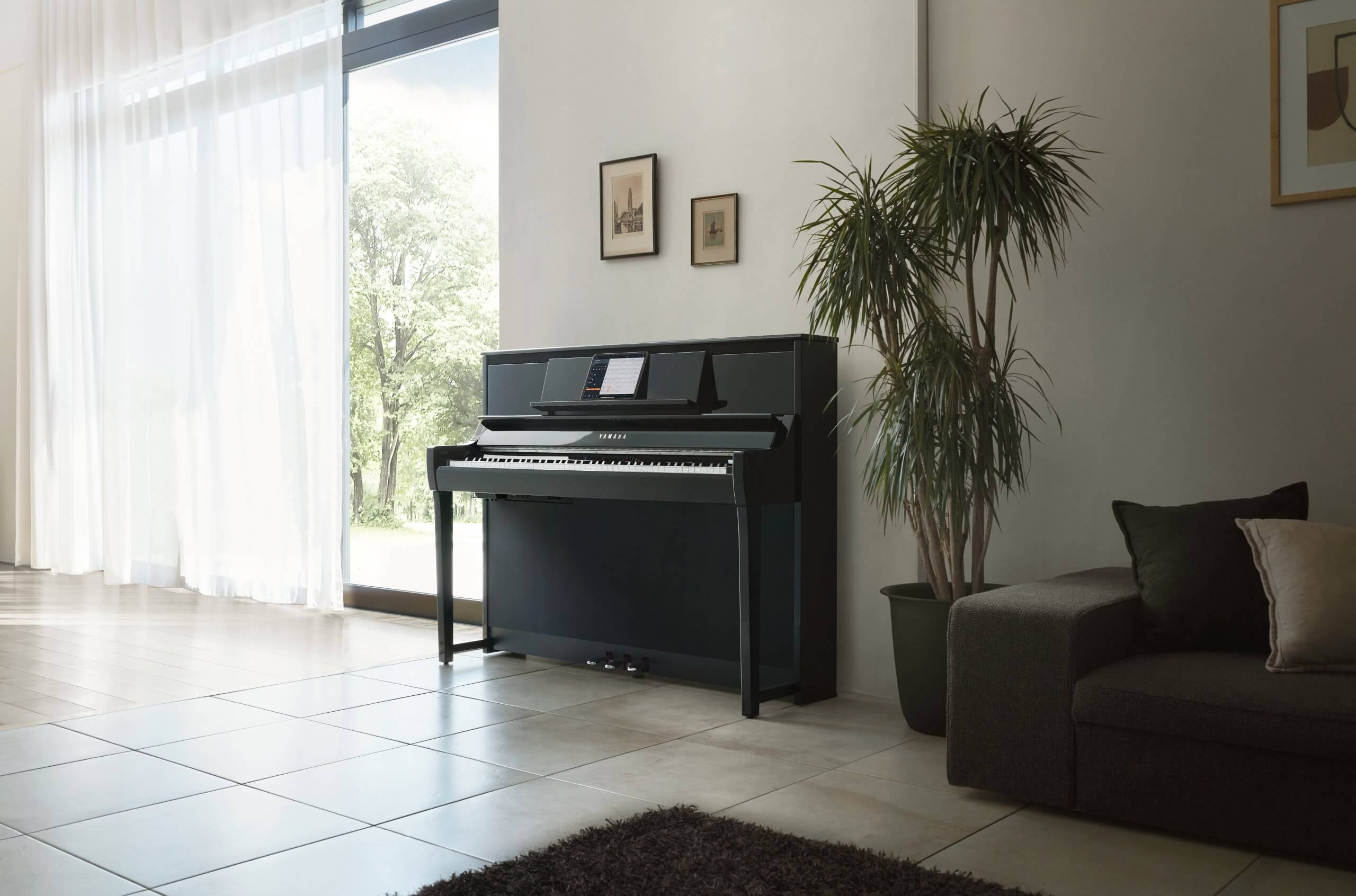
The Yamaha CSP-295 in polished ebony
Hang on, let me slow this down! I was playing on fast, and it was getting a little ahead of me, a little in fits and spurts, so my rhythm and timing were falling behind. So, I went to the settings, and I’ve changed the Stream Lights speed to slow, and let’s try again. Much better now!
Chris: I see you’re quite comfortable using both hands when you play rather than just one.
Jas: Yeah! I’m starting to get really comfortable with this, and I’m even keeping up with the backing track to what I feel is a respectable degree. The song doesn’t have so many pauses in there!
That really was a lot smoother and felt like I was playing in tune. And, if I use the guide, the piano will wait for me to play the right note before speeding off too much!
My sheet music reading is still really at an infant level, so I’m relying on the Stream Lights somewhat.
Chris: Do you think you can eventually wean yourself off the Stream Lights system and actually read the sheet music notes?
Jas: Oh yes, the Stream Lights are so useful for now and keep me practicing, and the backing music gives back, frankly, way more than I’m putting in! Basically, Stream Lights will provide me with some loose muscle memory on moving my fingers over the keys. Every note I play is, in effect, a type of practice and makes me more agile next time I play.
I should be able to remember roughly where notes are when I’m still relying on the little red LED Stream Lights over the keys, as I’ve got the sheet music displaying on the iPad anyway. I’m gradually becoming more familiar with it.
Chris: And you can disable the Stream Lights too, can’t you?
Jas: Yeah, here, let me disable them now and let’s try.
Chris: Okay.
Jas: So, as you can see, I’m much slower without the guide lights but, hey, I’m learning, and it’s so useful to have the music so clearly presented on a bright iPad at eye level. And, since I’ve still got the song loaded, I’m getting real-time feedback from the piano as the backing track and band still won’t progress unless I’m playing the correct note. Sure, it’s frustrating, and the playing is a little slow, but I’m definitely learning.
Jas: How do you feel about the
When you’re playing this piano, what do you enjoy the most about it and how does it compare to other top models like the CLP-785 – which we mentioned it will probably rival?
Chris: Well, firstly, like you mentioned, firstly the sheer presence of it! It’s quite a large and substantial piano – rather like the Yamaha upright pianos. In the polished ebony, it’s also a gorgeous piece of furniture. Compared to other models in our showroom, like the middle-range CLP ones, it actually feels quite special and its height makes it stand out.
[eptv]
And when I play the keys, even for the first time I laid hands on it, as an experienced player, I instantly notice that in comparison to the CLP models we have behind us such as CLP-735, CLP-745, the CSP-295 has striking fidelity of sound. It’s very sensitive.
Jas: Hey, even me, as a beginner, can notice the difference in sound. Let me go and hit a key on the CSP-275 on the bass end, and let’s compare. Now, hear the same on CSP-295. Woah, you can so hear the difference! The CSP-275 is a faithful sound of a piano, but, I’m telling you, on CSP-295, even I can hear it. It’s like you can actually feel the strings vibrating through your fingers, even though there aren’t any in there!
Chris: I guess that’s the power of the improved speaker and amplifier combo on CSP-295.
Jas: Yeah, and I didn’t even have the volume very high!
The Yamaha CSP-295 in duo mode
Chris: You know, this is such an important point because people shouldn’t be fooled into thinking it’s all about volume. It’s easy to think ‘well, I wouldn’t need to play very loudly anyway,’ but it’s about the dynamic range, that’s to say how much sensitivity the piano will allow you. How much expression. And CSP-295 struck me as a piano that will offer me no shortage of room to express myself through my playing.
Jas: Interesting. I mean, CSP-255 for educational purposes, for people right at the beginning, would be fabulous, but you’ve got to think what is your standard going to be in 5 years? Are you going to be outgrowing it?
Chris: The worst thing is to see beginners artificially limiting themselves through owning a piano that doesn’t have this type of room for expression.
Chris: Does having an iPad with the Yamaha Smart Pianist app make the CSP-295 a little more fun for you?
Jas: Oh, totally, it presents you with more options and makes it easier for you to navigate the sounds and choose which way to learn or play.
For example, let me go to the Piano Room. Look, I’ve got a grand piano right there on the screen displayed beautifully, and I can switch backgrounds
and play in cathedrals for a huge amount of echo or change to an upright piano in a schoolroom-type venue. Of course, it’s changing only the type of echo, but illustrated this way, it’s really cool.
Chris: You’re playing with the layers there and getting carried away!
Jas: Yes! I’m enjoying that. You can add two layers like grand piano and strings or vibraphone and just play. You can even load up the songs to learn as before, and this gives everything a fresh feel as you’re adding your own touch of orchestration to it. For a total, or nearly total newbie like me, it’s just fun to experiment, and the Smart Pianist app makes it so clear and easy to do.
Jas: I was watching you use the Style backings earlier. How does that work?
Chris: The Styles are really fun on CSP-295. It’s a fun way to feel like you’re playing in a band rather than just along with one. You’re actually acting as a type of conductor to a group, and you can choose the styles of music.
Jas: Why do you like that?
Chris: Well, rather than a one-dimensional piano – just turn on and play – like traditional pianos. There are times when I want the engagement and a way to test timing as a player by playing with a bassist and drummer and other instruments as if they were real humans in a band playing along with me.
With this big picture of a band on the iPad, it gives a good feel for the type of music I’m going to be playing even though each style is given a basic name like ‘Standard 8 Beat,’ etc. Underneath this picture, there are large boxes named A, B, C, D which allow me to have some control over the intensity of the backing band.
When I start with variation A, everything’s quite simple – as you’d expect in a basic rock/pop band. But when I change to B by pressing the screen, the guitarist gets a bit more interested and involved and starts playing a few licks to show off! You can hear the drums become more intense too.
Jas: Does it make your playing pick up as you go along too? That’s to say does it give you a lift using the backing styles?
Chris: Oh certainly! In fact, it reminds me of playing in a live band which I don’t get to anymore being married with kids! My playing becomes more active as I hear the bassline and drums working to crescendos in each bar of music, and I start adding my own little flurries of riffs on the keys. It really does give you a lift, yeah!
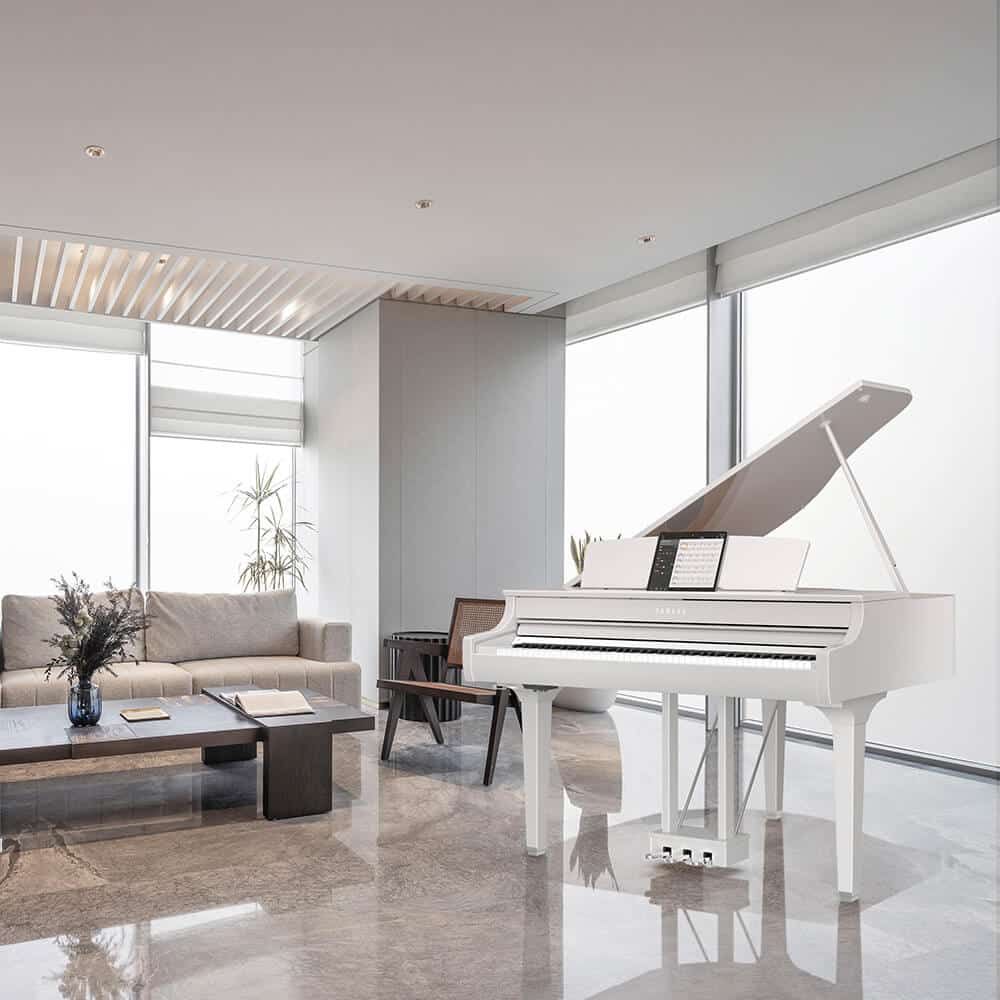
The Yamaha CSP-295GP
Jas: You know, with this instrument, it doesn’t sound like it’s just a piano sound coming from some speakers, as we see in some lower-end models. With those, you play a note and you kind of can see the speakers and you know the sound is clearly coming out of those. With CSP-295, when you’re sat playing it, I don’t really feel I can detect exactly where the sound is coming out of. It’s a very enveloping sound as you play or even sit next to it hearing it being played.
Chris: Absolutely, just like a traditional piano. The connection between player and piano is almost one, and it doesn’t feel as boxed in as some of the models with smaller speakers and lower-powered amplifiers.
Chris: So, overall, if money was no object, Jas,… Do you want to take one home?
Jas: Is that an offer? Haha. In actual fact, I feel like the CSP-295 would last me throughout my grades as I do them and become a better player.
Chris: I can see you’re already having fun and learning things in the time we’ve been sat here next to it!
Jas: Totally. I feel like my learning curve would shoot up with this model. What do you think? Would you have one at home and why – as an experienced player?
Chris: Yeah, 100%. Just the piano specification itself, I know would be enough to satisfy me. Add to that the fact I can plug my phone in, and load up my own music to play through speakers – I showed that in a video recently – makes it all the better.
It feels like a piano with all the mod cons you’d expect in this digital age, but, you take your iPad or iPhone off the music rest and voila! You’ve got yourself a beautiful, classic-looking piano again. It’ll look great in my house!
ePianos deliver across the UK mainland and offer award-winning customer service.
Sign up to our Newsletter
Enter your email address below to receive our free weekly newsletter containing the latest piano,
keyboard and organ demonstration videos, breaking news, special offers, invitations to our live video
events, technical support articles and much more.
Chris Hammond
Manager at ePianos
Chris handles all of our ePianos marketing, and is responsible for the creation and production of the majority of our product videos.
Chris is also one of our top blog writers, having extensive knowledge of keyboard instruments, years of experience in musical instrument retail, and a background in live performance and composition.
For more detailed information regarding delivery and returns, including our 14-day returns policy,
please click here.
Please note: UK mainland DOES NOT include the Channel Islands, or the Scottish
Highlands. Surcharges may apply, so please contact us for more information before purchase.
Additionally, our in-house team, courier delivery, and postal services neither deliver nor collect on Bank
Holidays, so there will be a delay during these periods.
Special Order items
These items are sold on behalf of Yamaha, and are sent to us on a per-order basis, typically within 5-7 working days, unless an ETA is otherwise stated.
We'll contact you the moment your purchase arrives with us to organise delivery, based on your selected option.
Brand new products over 30kg
Example products: Yamaha DGX670, Yamaha P-525, Yamaha YDP-S55, Yamaha Clavinova.
These items must be sent with a heavy-goods courier (typically APC or FedEx). On occasion, depending on which is fastest, we will drop-ship directly from Yamaha to your address via Dachser.
Tracking will be provided by the haulier, with a typical arrival time of 1-2 working days.
*If you have included the optional £180 "Yamaha Premium Service" home delivery & setup option offered on selected products, we will contact you regarding arrangements after purchase.
**The Yamaha CSP Series, Yamaha CVP905 & CVP909, Yamaha CLP875, 885 & 895GP, and Yamaha NU1Xa are all sold on behalf of Yamaha and arrive with us on a per-order basis. As soon as your piano has arrived, we will contact you to organise the appropriate dispatch method. ETA for stock is shown on the product page for those items.
***If you have included the optional £99 home delivery & setup option offered on selected products, we will send your details direct to the installation team, who will contact you within 48 hours to make arrangements.
Used or display products over 30kg
Depending on which option is most appropriate, we will either contact you to discuss a bespoke ePianos delivery surcharge for goods we can’t package for a 3rd party courier, or otherwise dispatch goods via FedEx or APC.
If a courier is used, tracking will be provided by them directly, with a typical arrival time of 1-2 working days.
All products under 30kg
Example products: Yamaha PSR-SX920, Yamaha P-225, Yamaha NP-15.
These items will be sent via courier (typically APC or FedEx). On occasion, depending on which is fastest, we will drop-ship directly from Yamaha to your address via UPS or Parcelforce.
Tracking will be provided by the courier, with a typical arrival time of 1-2 working days.
Smaller items, such as books, discs, etc, will be dispatched via Royal Mail second class.
Downloadable Content
After purchase, you can download the file either from the order confirmation page or the "Downloads" tab in "My Account".
If you have selected the option to receive a pre-loaded USB stick, then this will be dispatched via Royal Mail.
Pre-orders
We will contact you regarding any pre-ordered items, and let you know when they arrive so as to arrange delivery with you at a convenient time.
We offer interest-free and interest-bearing finance options on selected products.
Finance options for new products
2–5 years interest-bearing finance at 19.9% APR (minimum 10% deposit).
A minimum loan amount of £500 after deposit is required.
Finance options for used products
Used items can also be purchased using either of the following options
(minimum loan amount of £250 after deposit):
10 months at 0% APR (minimum 50% deposit)
6 months at 0% APR (minimum 10% deposit)
Representative Example
Cash price: £700
Deposit: £70
Loan amount: £630
APR representative: 19.9%
Interest rate: 19.9% p.a. fixed
36 monthly repayments of: £22.87
Total loan term: 36 months
Total amount payable: £893.32
Available finance options are displayed at checkout. Alternatively,
please get in touch
and we’ll be happy to discuss the options, or email a finance application to you. Find out more by clicking here
Seasonal Hours
Our seasonal opening hours are as follows:
Christmas Eve: 10am to 1.30pm
Christmas Day: Closed
Boxing Day: Closed
New Year's Eve: 10am to 1.30pm
New Year's Day: Closed
Bank Holidays
We are closed on all bank holidays, therefore the processing of sales and deliveries will be delayed.
Tyros Tipsters Bonus Content for Tyros 5
Here's what we offer when you select the option to include our Bonus Content...
We update the firmware so that your Yamaha Tyros 5 is running on the latest version
We load in 600 registrations into the Tyros 5 which give you sound set-ups in your
registration bank buttons for different genres of music
We add 1825 songs into the Tyros 5 Music Finder
Contact Us
We are pleased to be able to offer interest-free finance on selected products through Novuna Personal Finance, for a limited period only.
This offer is available on purchases of:
Brand New Yamaha Genos 2
Brand New & Used Yamaha SX920 (if purchased with bonus content & guide)
Used Yamaha SX900 (if purchased with bonus content & guide)
Used Yamaha Genos 1 (if purchased with bonus content & guide)
Get in touch to request a remote 0% finance application with or without a part-exchange using the form below:
Here's what we offer when you select the option to include our Bonus Content...
Latest Firmware
27 Expansion packs which include 557 voices and 381 backing styles
234 extra styles from Tyros 5
600 registrations
2673 song setups
Video showing where all the key features are
...and when you select the option to include our GenosTipsters Guide
We include our GenosTipsters guide (digital version) worth £99,
featuring over 3 hours of video and 200 pages of written accompaniment.
Disclaimer – a proportion of this content is made available freely by Yamaha,
for those fully competent and confident with using the required software to install it via computer.
Information about this item
For orders of any stock displaying a 7-10 day lead time, we will contact you as soon as the item arrives with us to schedule a delivery with you.
Occasionally, there may be availability issues with our suppliers, in which case we'll get in touch with you to see if you're happy to wait, or if you'd like to cancel the order and receive a full refund.
Information about this item
This is a special order "agency" item, and comes to us directly from Yamaha on a per-order basis.
It typically takes 7-10 days for this item to arrive with us, whereupon we'll contact you to discuss the arrangement of delivery.
Information about this item
For any pre-orders, we will contact you as soon as the item arrives with us to schedule a delivery with you, and update you with an ETA.
Occasionally, there may be availability issues with our suppliers, in which case we'll get in touch with you to see if you're happy to wait, or if you'd like to cancel the order and receive a full refund.
Get up to £250 cashback from Yamaha*
Yamaha is offering customers cashback on selected purchases until January 15th 2026 - here's how it works:
Purchase a qualifying Yamaha instrument before 15.01.26.
Complete the claim form
following this link
and have your proof of purchase and serial number ready.
Once your claim has been validated, you will be sent within 35 working days your cashback reward via bank transfer.
*Cashback amount varies product to product, as indicated.
Available Content for Genos 1
Here's what we include when you select the option to add our Bonus Content...
Latest Firmware
23 extra expansion packs which include 877 voices and 577 backing styles
234 extra styles from Tyros 5
600 registrations
4096 song setups
Video showing where all the key features are
...and when you select the option to include our GenosTipsters Guide
We include our GenosTipsters guide (digital version) worth £99,
featuring over 3 hours of video and 200 pages of written accompaniment.
Disclaimer – a proportion of this content is made available freely by Yamaha,
for those fully competent and confident with using the required software to install it via computer.
Part Exchange
Genos Tipsters Bonus Content for SX900
Here's what we offer when you select the option to include our Bonus Content...
Latest Firmware
14 Expansion Packs inc many extra voices and styles
234 T5 styles
600 registrations
T5 Music Finder
15 Playlists with 2287 song set-ups
Video showing where all the key features are
...and when you select the option to include our GenosTipsters Guide
We include our GenosTipsters guide (digital version) worth £99,
featuring over 3 hours of video and 200 pages of written accompaniment.
Disclaimer – a proportion of this content is made available freely by Yamaha,
for those fully competent and confident with using the required software to install it via computer.
Available Bonus Content for SX920
Here's what we offer when you select the option to include our Bonus Content...
Latest Firmware
25 Expansion packs which include 780 voices and 540 backing styles
234 extra styles from Tyros 5
600 registrations
4256 song setups including 136 ‘Decades’ registrations
Video showing where all the key features are
...and when you select the option to include our GenosTipsters Guide
We include our GenosTipsters guide (digital version) worth £99,
featuring over 3 hours of video and 200 pages of written accompaniment.
Disclaimer – a proportion of this content is made available freely by Yamaha,
for those fully competent and confident with using the required software to install it via computer.
Bonus Content for Korg Pa5X
Here's what we include when you select the option to add our Bonus Content...
Korg Bonus Styles (Taken from the Bonusware downloads on Korg UK website) – 450 styles
Korg Pa2x Internal Styles converted to 5x – 419 styles, all complete with 4 x Keyboard Sets
Korg Pa3x Internal Styles converted to 5x – 486 styles, all complete with 4 x Keyboard Sets
Korg Pa4x Internal Styles converted to 5x – 584 styles, all complete with 4 x Keyboard Sets
Korg Pa800 Internal Styles converted to 5x – 409 styles, all complete with 4 x Keyboard Sets
Korg Musikant 4x Internal Styles converted to 5x – 577 styles, all complete with 4 x Keyboard Sets
ePianos Songbook for Pa5x – A collection of over 200 well-known songs with 4 Keyboard Sets per song, giving in
excess of 800 registrations
Latest Osimo Songbook from Korg
3 x User Sound Packs from Korg
6 x Korg Pa5x User Know How videos covering: "Power Up & Panel", "Selecting Styles", "Selecting Sounds", "My
Setting & Favourites", "Mixer Basics", "Songbook", and "Recording"
How to Locate and Load the Various Software Bundle Components (Video)
Available Bonus Content for Genos 2
Here's what we offer when you select the option to include our Bonus Content:
Latest Firmware
52 expansion packs which include 1,721 voices and 1,148 backing styles
234 extra styles from Tyros 5
816 registrations
4256 song setups including 160 ‘Decades’ registrations
Video showing where all the key features are
Some of the best parts of our Bonus Content option are the 1,721 new extra voices and 1,148 new extra styles
included
across 52 expansion packs. These packs are quite complex to upload and, whilst free to obtain, we pride ourselves on
getting them into your keyboard for you — something many dealers shy away from purely because of the time it takes
to get them uploaded.
...and when you select the option to include our GenosTipsters Guide:
We include our GenosTipsters guide (digital version) worth £99,
featuring over 3 hours of video and 200 pages of written accompaniment.
Disclaimer – a proportion of this content is made available freely by Yamaha,
for those fully competent and confident with using the required software to install it via computer.














Comments: