We are digital piano & keyboard specialists, based in Banbury, Oxfordshire. Stay up to date with the latest
news, reviews, tips, and offers by joining our FREE newsletter (unsubscribe at any time).
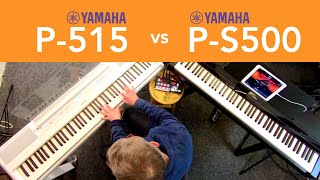
Yamaha P-S500 vs P-515 – What are the differences?
"What becomes obvious in this comparison is that these two models are simply designed for different purposes. There’s a lot of crossover in the basics of what they offer - they’re both pianos after all!.."
Here’s my comparison of two brilliant portable pianos: It’s the Yamaha P-S500 vs P-515.
Below, I’ll explain the main differences between these two models which are often compared because they’re in the same range and in a similar price bracket.
Yamaha P-S500 (left) – Yamaha P-515 (right). Note: The stands shown are optional extras.
The basic design features are the same.
At first glance, they look quite similar, and there are many similarities. For example, they both have the standard amount of keys for a piano: 88.
Looking at the chassis, they’re both obviously designed to be relatively portable. They’re narrow and fairly compact. Neither is supplied with a stand in the box, but are flat underneath – meaning you can put them on a tabletop or a fold-up portable stand, etc.
This blog is all about the differences between these two models. Hopefully, it’ll help you decide which one is right for you.
Chris explains the main differences between the Yamaha P-S500 & P-515 portable pianos
Difference #1 – The Stream Lights Learning System
The major difference that stands out to me is that the Yamaha P-S500 has an integrated, visual learning system called Stream Lights and is very much designed to assist people who are either complete beginners or that prefer learning in a visual way, perhaps because they don’t get along with traditional learning methods like reading music.
The Stream Lights learning system uses lights that appear on a panel above the keys. They ‘fall’ down towards the keys showing you which notes to play, and crucially, which notes to play next for your selected song.
This system is extremely easy to use. Even complete beginners are able to sit down at this piano, follow the Stream Lights to learn music, and play along with the backing songs.
The Yamaha P-515 does not include the integrated Stream Lights learning system.
Here, you can see the Stream Lights learning system on the Yamaha P-S500.
Difference #2 – The Piano-Style Key Mechanisms
The Yamaha P-515 has a superior weighted key mechanism. This means that playing it is a more authentic representation of playing a traditional piano than playing the P-S500.
While both models do have weighted keys, the P-515 uses a more advanced mechanism called NWX (Natural Wood X). The white keys are actually wooden – just like on a traditional piano – which makes them more authentic to play.
Speaking of being authentic to play, the X part of NWX action indicates that there is a simulated escapement mechanism included too.
On traditional pianos, the escapement is what allows the hammer to be released from the string after striking it – even when the key is still depressed, allowing the string to continue vibrtating.
There are no strings in a digital piano, of course, however, the feeling of the escapement mechanism (which feels like a little bump at the end of the key travel) is not insignificant on traditional pianos, and the inclusion of it on the P-515, as well as the synthetic ebony and ivory keytops, indicates the level of detail that Yamaha go into to recreate the real experience of playing a traditional piano.
The Yamaha P-515 features wooden white keys for ultra-realism.
In comparison, the Yamaha P-S500, while it does have ‘weighted keys’, uses an inferior mechanism called GHS (Graded Hammer Standard).
While this system is perfectly adequate for beginners, and even intermediate-level players, it’s, without a doubt, an area where the P-S500 is inferior to the P-515. The GHS key mechanism is the same as can be found on the student-level Yamaha P45 model.
If you play the piano to a high standard, I’m almost certain that you’ll be able to feel instantly how the wooden keys on the P-515 allow your fingers to move more nimbly over the keyboard – particularly when playing fast passages.
Difference #3 – The Rhythms & Accompaniments
This is an area where there’s significant divergence in what these two pianos offer, and there’s no doubt whatsoever that the P-S500 offers far more than the P-515.
The P-515 will give you x40 ‘Rhythms’ of various different musical genres, but they’re so basic that I only really consider them good for practice purposes. They’re a little like glorified metronomes.
They give you a simple drum beat backing and a very basic Bass Guitar which follows your chord inputs on the keyboard. There are no proper introductions, variations, drum fills, or endings, so you can’t really put together anything like a polished live performance.
In comparison, the Rhythms & Accompaniments on the P-S500 are just miles, and miles better. And, when you’ve got the companion app connected (more on this next), you have more than x600 to play with!
Not only do you have hundreds of different music styles and genres to choose from, but the backings themselves contain multiple instruments and patterns making it genuinely sound like you’re performing as part of a complete band or orchestra.
There are multiple variations within the Styles too that help you build up the intensity of a song through verses, middle 8s, and choruses. Plus, you’re able to use pro-sounding introductions and ending to put together polished performances.
If you’re familiar with the Yamaha CVP, Tyros/Genos, and PSR models, you’ll understand the depth of variation that I’m referring to on these types of backing accompaniments.
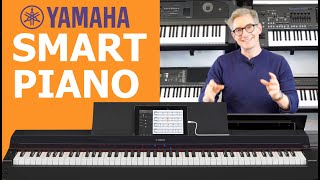
The Yamaha Smart Pianist app unlocks hundreds of additional backing styles on the P-S500.
Difference #4 – The Yamaha Smart Pianist App
Yamaha’s superb Smart Pianist app is designed to work with many of their digital pianos and is compatible with both the P-515 and P-S500.
However, aside from the basic functionality of controlling the Voices, there’s a significant difference in what the app brings to each of these models.
When using the Smart Pianist app with the Yamaha P-515, the app only shows you what’s already available on the piano. For example, you can change the onboard voices, layer the onboard voices, select an onboard rhythm, change the tempo, etc.
It acts like a portal to what’s already built into the P-515.
When using the Smart Pianist app with the Yamaha P-S500, you actually unlock loads of extra Voices, backing Styles, Songs, recording functionality, and more. Only a tiny fraction of which would be available if you were using the piano as a stand-alone model.
Here’s an example of what I mean:
560 additional Voices (100 when not using Smart Pianist app)
303 additional preset Songs (100 when not using Smart Pianist app)
270 additional backing Styles (100 when not using Smart Pianist app)
53 different types of reverb (5 when not using Smart Pianist app)
16-track recording (none when not using Smart Pianist app)
As you can see, while the P-S500 can be used without a smart device, it really should be used with one. In my opinion, it’s practically essential because it brings you much more than simply using the P-S500 as a stand-alone piano.
See my full P-S500 video review below for more details on what the Yamaha Smart Pianist app can do.
Chris reviews & demonstrates the Yamaha P-S500 Smart Piano.
Difference #5 – The Main Piano Sounds Compared.
Both of these pianos use the same main piano sample from Yamaha’s world-renowned CFX Concert Grand Piano. They also both contain the beautiful Bosendorfer Imperial Grand.
Spec-wise, there’s nothing significant between them, however, I want to give you my opinion of the playing experience.
I’ll get straight to it: For someone with my playing experience (25 years+), I think the Yamaha P-515 is superior.
Why? Because it feels to me like a more natural playing experience. Firstly, the touch (with the wooden keys) instantly feels ‘right’ when I lay my hands on it, and encourages a more natural flow in my playing.
Consequently, the way I attack the notes changes in response. I’m inputting more nuance in my keystrokes because the keyboard and speakers seem to respond to it. It feels more attuned to my playing standard and style.
The Yamaha P-515 offers a very natural playing experience for advanced players.
Playing the P-S500 is not the same experience. Bare in mind that I’m someone who has played many different models of digital piano and keyboard over my 15+ years in the industry – so I’ve become ultra-choosy!
I do think, however, that to a beginner, the difference is not going to be instantly noticeable.
The P-S500 does have a good weighted key mechanism, it feels realistic, and, if I was teaching a beginner and they said they were practicing on this model between lessons, I’d be quite happy!
However, in comparison to the P-515, I find the P-S500 a little stiff and one-dimensional to play. The plastic keys don’t respond to the variation of my inputs with the same agility as the P-515’s wooden keys.
It’s shouldn’t be a deal-breaker, but as I’m comparing the two, I want to be as honest as I can, and that’s just how I feel about them!
Yamaha P-515 (left) & P-S500 (right)
Summary: They’re Made For Different Purposes.
What becomes obvious in this comparison is that these two models are simply designed for different purposes. There’s a lot of crossover in the basics of what they offer – they’re both pianos after all!
However, I think a fair conclusion would be that the Yamaha P-S500 is designed to aid people that are learning to play, and who like using technology like backing accompaniments, and smart devices.
In comparison, the Yamaha P-515 is designed to offer a premium-level playing experience and to facilitate the greater requirements – the sensitivities, articulation, and subtleties – of a higher standard of playing.
Sign up to our Newsletter
Enter your email address below to receive our free weekly newsletter containing the latest piano,
keyboard and organ demonstration videos, breaking news, special offers, invitations to our live video
events, technical support articles and much more.
Chris Hammond
Manager at ePianos
Chris handles all of our ePianos marketing, and is responsible for the creation and production of the majority of our product videos.
Chris is also one of our top blog writers, having extensive knowledge of keyboard instruments, years of experience in musical instrument retail, and a background in live performance and composition.
For more detailed information regarding delivery and returns, including our 14-day returns policy,
please click here.
Please note: UK mainland DOES NOT include the Channel Islands, or the Scottish
Highlands. Surcharges may apply, so please contact us for more information before purchase.
Additionally, our in-house team, courier delivery, and postal services neither deliver nor collect on Bank
Holidays, so there will be a delay during these periods.
Special Order items
These items are sold on behalf of Yamaha, and are sent to us on a per-order basis, typically within 5-7 working days, unless an ETA is otherwise stated.
We'll contact you the moment your purchase arrives with us to organise delivery, based on your selected option.
Brand new products over 30kg
Example products: Yamaha DGX670, Yamaha P-525, Yamaha YDP-S55, Yamaha Clavinova.
These items must be sent with a heavy-goods courier (typically APC or FedEx). On occasion, depending on which is fastest, we will drop-ship directly from Yamaha to your address via Dachser.
Tracking will be provided by the haulier, with a typical arrival time of 1-2 working days.
*If you have included the optional £180 "Yamaha Premium Service" home delivery & setup option offered on selected products, we will contact you regarding arrangements after purchase.
**The Yamaha CSP Series, Yamaha CVP905 & CVP909, Yamaha CLP875, 885 & 895GP, and Yamaha NU1Xa are all sold on behalf of Yamaha and arrive with us on a per-order basis. As soon as your piano has arrived, we will contact you to organise the appropriate dispatch method. ETA for stock is shown on the product page for those items.
***If you have included the optional £99 home delivery & setup option offered on selected products, we will send your details direct to the installation team, who will contact you within 48 hours to make arrangements.
Used or display products over 30kg
Depending on which option is most appropriate, we will either contact you to discuss a bespoke ePianos delivery surcharge for goods we can’t package for a 3rd party courier, or otherwise dispatch goods via FedEx or APC.
If a courier is used, tracking will be provided by them directly, with a typical arrival time of 1-2 working days.
All products under 30kg
Example products: Yamaha PSR-SX920, Yamaha P-225, Yamaha NP-15.
These items will be sent via courier (typically APC or FedEx). On occasion, depending on which is fastest, we will drop-ship directly from Yamaha to your address via UPS or Parcelforce.
Tracking will be provided by the courier, with a typical arrival time of 1-2 working days.
Smaller items, such as books, discs, etc, will be dispatched via Royal Mail second class.
Downloadable Content
After purchase, you can download the file either from the order confirmation page or the "Downloads" tab in "My Account".
If you have selected the option to receive a pre-loaded USB stick, then this will be dispatched via Royal Mail.
Pre-orders
We will contact you regarding any pre-ordered items, and let you know when they arrive so as to arrange delivery with you at a convenient time.
Spread the cost with 0% APR interest-free finance
on selected products.
Interest-free finance options
Choose from two options, with a minimum loan amount of £250
after your deposit:
Here's what we offer when you select the option to include our Bonus Content...
Latest Firmware
27 Expansion packs which include 557 voices and 381 backing styles
234 extra styles from Tyros 5
600 registrations
2673 song setups
Video showing where all the key features are
...and when you select the option to include our GenosTipsters Guide
We include our GenosTipsters guide (digital version) worth £99,
featuring over 3 hours of video and 200 pages of written accompaniment.
Disclaimer – a proportion of this content is made available freely by Yamaha,
for those fully competent and confident with using the required software to install it via computer.
Information about this item
For orders of any stock displaying a 7-10 day lead time, we will contact you as soon as the item arrives with us to schedule a delivery with you.
Occasionally, there may be availability issues with our suppliers, in which case we'll get in touch with you to see if you're happy to wait, or if you'd like to cancel the order and receive a full refund.
Information about this item
This is a special order "agency" item, and comes to us directly from Yamaha on a per-order basis.
It typically takes 7-10 days for this item to arrive with us, whereupon we'll contact you to discuss the arrangement of delivery.
Information about this item
For any pre-orders, we will contact you as soon as the item arrives with us to schedule a delivery with you, and update you with an ETA.
Occasionally, there may be availability issues with our suppliers, in which case we'll get in touch with you to see if you're happy to wait, or if you'd like to cancel the order and receive a full refund.
Claim Up To £50 Yamaha Cashback
Buy an eligible Yamaha piano or keyboard from us between
26th August 2026 and 13th January 2027
and claim cashback directly from Yamaha.
Yamaha P-145BT: £40 cashback
Yamaha P-225: £50 cashback
Yamaha PSR-E483: £30 cashback
Yamaha PSR-E583: £30 cashback
How To Claim
Sign in or create a free Yamaha Music Connect account.
Register your new instrument using its serial number.
Complete Yamaha’s cashback claim form within 60 days of purchase.
You’ll need your proof of purchase, so please keep your ePianos
order confirmation or receipt.
Cashback is provided and paid directly by Yamaha and is not
deducted from the price at checkout. Qualifying new instruments
only. Purchases and claims are subject to Yamaha’s full promotional
terms and conditions.
Available Content for Genos 1
Here's what we include when you select the option to add our Bonus Content...
Latest Firmware
23 extra expansion packs which include 877 voices and 577 backing styles
234 extra styles from Tyros 5
600 registrations
4096 song setups
Video showing where all the key features are
...and when you select the option to include our GenosTipsters Guide
We include our GenosTipsters guide (digital version) worth £99,
featuring over 3 hours of video and 200 pages of written accompaniment.
Disclaimer – a proportion of this content is made available freely by Yamaha,
for those fully competent and confident with using the required software to install it via computer.
Part Exchange
Genos Tipsters Bonus Content for SX900
Here's what we offer when you select the option to include our Bonus Content...
Latest Firmware
14 Expansion Packs inc many extra voices and styles
234 T5 styles
600 registrations
T5 Music Finder
15 Playlists with 2287 song set-ups
Video showing where all the key features are
...and when you select the option to include our GenosTipsters Guide
We include our GenosTipsters guide (digital version) worth £99,
featuring over 3 hours of video and 200 pages of written accompaniment.
Disclaimer – a proportion of this content is made available freely by Yamaha,
for those fully competent and confident with using the required software to install it via computer.
Available Bonus Content for SX920
Here's what we offer when you select the option to include our Bonus Content...
Latest Firmware
25 Expansion packs which include 780 voices and 540 backing styles
234 extra styles from Tyros 5
600 registrations
4256 song setups including 136 ‘Decades’ registrations
Video showing where all the key features are
...and when you select the option to include our GenosTipsters Guide
We include our GenosTipsters guide (digital version) worth £99,
featuring over 3 hours of video and 200 pages of written accompaniment.
Disclaimer – a proportion of this content is made available freely by Yamaha,
for those fully competent and confident with using the required software to install it via computer.
Bonus Content for Korg Pa5X
Here's what we include when you select the option to add our Bonus Content...
Korg Bonus Styles (Taken from the Bonusware downloads on Korg UK website) – 450 styles
Korg Pa2x Internal Styles converted to 5x – 419 styles, all complete with 4 x Keyboard Sets
Korg Pa3x Internal Styles converted to 5x – 486 styles, all complete with 4 x Keyboard Sets
Korg Pa4x Internal Styles converted to 5x – 584 styles, all complete with 4 x Keyboard Sets
Korg Pa800 Internal Styles converted to 5x – 409 styles, all complete with 4 x Keyboard Sets
Korg Musikant 4x Internal Styles converted to 5x – 577 styles, all complete with 4 x Keyboard Sets
ePianos Songbook for Pa5x – A collection of over 200 well-known songs with 4 Keyboard Sets per song, giving in
excess of 800 registrations
Latest Osimo Songbook from Korg
3 x User Sound Packs from Korg
6 x Korg Pa5x User Know How videos covering: "Power Up & Panel", "Selecting Styles", "Selecting Sounds", "My
Setting & Favourites", "Mixer Basics", "Songbook", and "Recording"
How to Locate and Load the Various Software Bundle Components (Video)
Available Bonus Content for Genos 2
Here's what we offer when you select the option to include our Bonus Content:
Latest Firmware
52 expansion packs which include 1,721 voices and 1,148 backing styles
234 extra styles from Tyros 5
816 registrations
4256 song setups including 160 ‘Decades’ registrations
Video showing where all the key features are
Some of the best parts of our Bonus Content option are the 1,721 new extra voices and 1,148 new extra styles
included
across 52 expansion packs. These packs are quite complex to upload and, whilst free to obtain, we pride ourselves on
getting them into your keyboard for you — something many dealers shy away from purely because of the time it takes
to get them uploaded.
...and when you select the option to include our GenosTipsters Guide:
We include our GenosTipsters guide (digital version) worth £99,
featuring over 3 hours of video and 200 pages of written accompaniment.
Disclaimer – a proportion of this content is made available freely by Yamaha,
for those fully competent and confident with using the required software to install it via computer.

















Comments:
Thanks for this great comparison! Much appreciated.
January 13th., 2024
“e P”
Sir: “Chris Hammon”:
Receive you, a warm greeting, and all my thanks for the interesting and important INFORMATION that you have
been able to provide about the -Differences- between the “YAMAHA” Piano Model P-S500 and the Piano Model P-
525.
It has been all a great information that I have learned, according to your explanation; and that will help me to know
which of the -Two Pianos- is the one that I really need. And where you have been able to SPECIFY with much
ACCURACY and PROFESSIONALISM, according to your “EXPERIENCE”.
Thank you once again for your service to the community of those interested in learning about Modern Digital
Pianos!
From you, with all respect and admiration
Mr. “Hannibal Selas”