

The dilemmas you’ll face when choosing your child’s first piano: Part 2
This time, I'll be talking about touch sensitivity and weighted keys...
We are digital piano & keyboard specialists, based in Banbury, Oxfordshire. Stay up to date with the latest news, reviews, tips, and offers by joining our FREE newsletter (unsubscribe at any time).


A piano is a big investment, there is no denying that. Whether you choose portable or stationary, there is ££ to be spent. Therefore, doing your research before buying is always going to save money in the long run.
In this blog, I’m going to break down some of the technical language that may arise when you look through different specifications for different pianos or hear from your child’s piano teacher.

Touch-sensitive keys react to touch according to how softly/firmly played.
This means that from the start your child will begin to learn how much pressure to apply to get a louder or softer sound. It is very frustrating for a young child to not have this facility and press lightly but not get any dynamic change to when they press with more velocity.
Most keyboards and pianos can be changed to be either fixed, soft, medium, or hard sensitivity, something that is super for very young children who just don’t yet have the muscle development in their fingers.

An acoustic piano has small lead weights in the makeup of each key, called key leads that affect the weight of each note. In an acoustic piano, lower notes will have heavier key leads than higher keys.
In order to replicate this feel, digital keyboards and pianos have semi or fully-weighted keys, however without the graded hammer action, these will all feel the same weight up and down the keyboard.
The Clavinova CLP series and Arius have weighted keys that are graded.
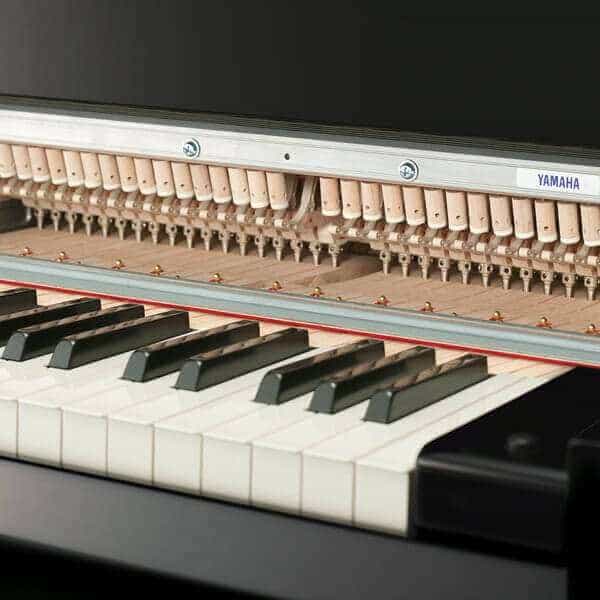
Graded hammer action relates to the hammer action against the felt in an acoustic piano. Obviously, in a digital piano, this doesn’t happen physically, but the effect has been replicated.
The GHS (graded hammer standard) keyboard is graduated in groups, the bass area is heavy and the treble, light. These are perfectly suited for young beginners. The groupings might be octaves of notes, for example, C1 to C2, or less depending how high the specification is of the instrument.
The GH3 is the same as a GHS but just with an added damper sensor in the hammer action. It also swings back faster so the weight of the key can be felt when played for a second time in quick succession. So obviously better suited to more intermediate/advanced playing.
 26m
26m
Watch Chris's demonstration of the piano sounds on the Yamaha CLP-785 digital piano
The Yamaha CLP 775 and CLP 785 both have Linear graded hammers, this means that each note on the piano is weighted dependent on its position on the piano, so C1 will be weighted differently to D1 and very differently to C or D2.
Ideally, if you can stretch to a piano with graded hammer action as well as the weighted keys, there will be a far more realistic feel to playing.
Don’t forget the team at ePianos are always on hand to answer your questions. Just drop us a line.
Enter your email address below to receive our free weekly newsletter containing the latest piano, keyboard and organ demonstration videos, breaking news, special offers, invitations to our live video events, technical support articles and much more.


These items are sold on behalf of Yamaha, and are sent to us on a per-order basis, typically within 5-7 working days, unless an ETA is otherwise stated.
We'll contact you the moment your purchase arrives with us to organise delivery, based on your selected option.
Example products: Yamaha DGX670, Yamaha P-525, Yamaha YDP-S55, Yamaha Clavinova.
These items must be sent with a heavy-goods courier (typically APC or FedEx). On occasion, depending on which is fastest, we will drop-ship directly from Yamaha to your address via Dachser.
Tracking will be provided by the haulier, with a typical arrival time of 1-2 working days.
*If you have included the optional £180 "Yamaha Premium Service" home delivery & setup option offered on selected products, we will contact you regarding arrangements after purchase.
**The Yamaha CSP Series, Yamaha CVP905 & CVP909, Yamaha CLP875, 885 & 895GP, and Yamaha NU1Xa are all sold on behalf of Yamaha and arrive with us on a per-order basis. As soon as your piano has arrived, we will contact you to organise the appropriate dispatch method. ETA for stock is shown on the product page for those items.
***If you have included the optional £99 home delivery & setup option offered on selected products, we will send your details direct to the installation team, who will contact you within 48 hours to make arrangements.
Depending on which option is most appropriate, we will either contact you to discuss a bespoke ePianos delivery surcharge for goods we can’t package for a 3rd party courier, or otherwise dispatch goods via FedEx or APC.
If a courier is used, tracking will be provided by them directly, with a typical arrival time of 1-2 working days.
Example products: Yamaha PSR-SX920, Yamaha P-225, Yamaha NP-15.
These items will be sent via courier (typically APC or FedEx). On occasion, depending on which is fastest, we will drop-ship directly from Yamaha to your address via UPS or Parcelforce.
Tracking will be provided by the courier, with a typical arrival time of 1-2 working days.
Smaller items, such as books, discs, etc, will be dispatched via Royal Mail second class.
After purchase, you can download the file either from the order confirmation page or the "Downloads" tab in "My Account".
If you have selected the option to receive a pre-loaded USB stick, then this will be dispatched via Royal Mail.
We will contact you regarding any pre-ordered items, and let you know when they arrive so as to arrange delivery with you at a convenient time.

Used items can also be purchased using either of the following options (minimum loan amount of £250 after deposit):
Total amount payable: £893.32
Available finance options are displayed at checkout. Alternatively, please get in touch and we’ll be happy to discuss the options, or email a finance application to you. Find out more by clicking here

Our seasonal opening hours are as follows:

We are closed on all bank holidays, therefore the processing of sales and deliveries will be delayed.

For orders of any stock displaying a 7-10 day lead time, we will contact you as soon as the item arrives with us to schedule a delivery with you.
Occasionally, there may be availability issues with our suppliers, in which case we'll get in touch with you to see if you're happy to wait, or if you'd like to cancel the order and receive a full refund.
This is a special order "agency" item, and comes to us directly from Yamaha on a per-order basis.
It typically takes 7-10 days for this item to arrive with us, whereupon we'll contact you to discuss the arrangement of delivery.
For any pre-orders, we will contact you as soon as the item arrives with us to schedule a delivery with you, and update you with an ETA.
Occasionally, there may be availability issues with our suppliers, in which case we'll get in touch with you to see if you're happy to wait, or if you'd like to cancel the order and receive a full refund.

*Cashback amount varies product to product, as indicated.

Comments: