

The dilemmas you’ll face when choosing your child’s first piano: Part 1
The initial questions
We are digital piano & keyboard specialists, based in Banbury, Oxfordshire. Stay up to date with the latest news, reviews, tips, and offers by joining our FREE newsletter (unsubscribe at any time).


It started with a violin…then the drums…you’ve settled on a piano (it was either that or a puppy!).
The lessons have started but you are now faced with the dilemma of what they can use to practice on.
It’s a tricky dilemma that many parents face, do you spend lots of money on a piano and then they give up, or do you buy something less fancy but they need something progressive very quickly so you need to buy twice?
I’ve tried to address some questions that arise frequently below.
Please feel free to comment below or give us a call in the shop if you have further questions that we can try to help answer.

The full length of a regular acoustic piano is 88 keys. The majority of digital pianos also have 88 keys, but do you NEED all 88 keys when your child is beginning to learn?
In truth, no. I’m sure some teachers may disagree with me, but other than initial exercises finding all the C’s on the keyboard and some fun chromatics where students love to show their speedy chromatics for the whole instrument, the extra 6 keys on each end, are primarily redundant for a beginner.
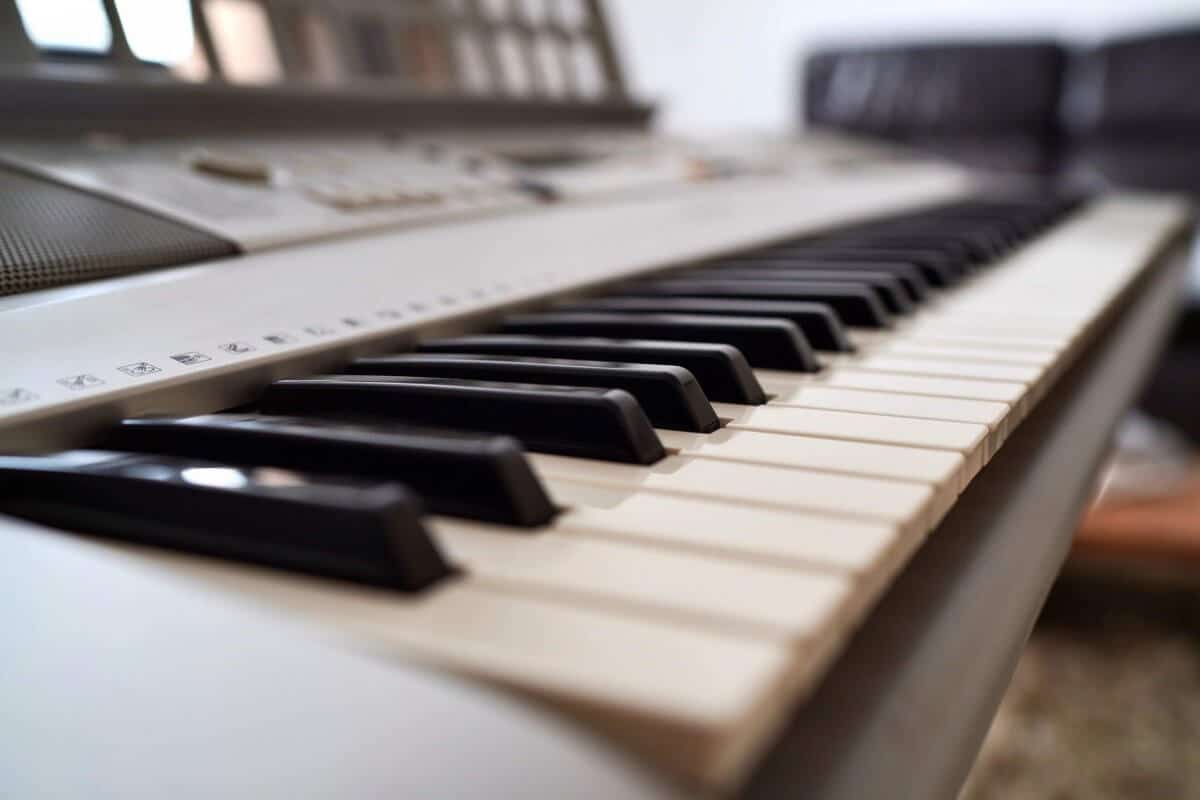
In my opinion, this is the one area you can’t cut corners. It might be appealing to save some money and get a simple keyboard as they do LOOK similar, but the weighted keys are vital at a young age.
It will help your child to appreciate how firmly or softly they need to push the key down and they will garner how in control they are of the sound through their fingers.
Most pianos and portable pianos are weighted keys these days, or at the very least, semi-weighted, but the latter is the least you want to have on your instrument.
 25m
25m
Watch David explain the choices that beginners' face when choosing a new piano
Pianos are amazing, but they do take up space. If you have the space for the cabinet, that’s great, but if you are more limited, then there are perfectly suitable portable pianos or slimline pianos available today such as the Yamaha Arius YDPS35 or S55.
The advantage of a portable piano is that it can be put away when needed, the disadvantage is the old saying ‘out of sight, out of mind’ and the piano in the cupboard soon gets forgotten.
The other extra part of a portable piano is ensuring you have something of the appropriate height to put it onto safely and securely.
We do have various stands, but you need to take into consideration the purchase of these as extra, or, if you decide to use a table, how high is that table and the respective chair?
The posture and hand position at the piano is not only crucial for developing good style but also for preventing wrist, hand, or shoulder pain.

I have written some blogs on this subject here & and here
In truth, the Yamaha P515 is a piano. It is portable, it has graded hammer action, escapement, and wooden keys just like the Clavinova CLP745 upwards.
It is perfectly suited for seeing a student through lots of grades.
However, its price is similar to the Yamaha CLP735 once you have factored in the price of the stand and pedal kit.

Ultimately in the early days, no, but it is something that they will soon require. I have young students who begin learning how to manipulate a pedal even before they get to around grade 1 as I personally feel it’s important to understand how the whole instrument works together. Does this need to be all three pedals, no, a damper is really the only one required initially.
Of course. So there are several options out there for this: some of the portable, weighted 88 key pianos start from as little as £345 up to something that will give you a lot of longevity, but set you back up to £5000.
The other option is to consider a pre-loved piano. For an instrument that may be slightly older, yet offer just as much or more than a mid-budget instrument, you could get quite a bargain.
You can check out our used pianos below.
Enter your email address below to receive our free weekly newsletter containing the latest piano, keyboard and organ demonstration videos, breaking news, special offers, invitations to our live video events, technical support articles and much more.


These items are sold on behalf of Yamaha, and are sent to us on a per-order basis, typically within 5-7 working days, unless an ETA is otherwise stated.
We'll contact you the moment your purchase arrives with us to organise delivery, based on your selected option.
Example products: Yamaha DGX670, Yamaha P-525, Yamaha YDP-S55, Yamaha Clavinova.
These items must be sent with a heavy-goods courier (typically APC or FedEx). On occasion, depending on which is fastest, we will drop-ship directly from Yamaha to your address via Dachser.
Tracking will be provided by the haulier, with a typical arrival time of 1-2 working days.
*If you have included the optional £180 "Yamaha Premium Service" home delivery & setup option offered on selected products, we will contact you regarding arrangements after purchase.
**The Yamaha CSP Series, Yamaha CVP905 & CVP909, Yamaha CLP875, 885 & 895GP, and Yamaha NU1Xa are all sold on behalf of Yamaha and arrive with us on a per-order basis. As soon as your piano has arrived, we will contact you to organise the appropriate dispatch method. ETA for stock is shown on the product page for those items.
***If you have included the optional £99 home delivery & setup option offered on selected products, we will send your details direct to the installation team, who will contact you within 48 hours to make arrangements.
Depending on which option is most appropriate, we will either contact you to discuss a bespoke ePianos delivery surcharge for goods we can’t package for a 3rd party courier, or otherwise dispatch goods via FedEx or APC.
If a courier is used, tracking will be provided by them directly, with a typical arrival time of 1-2 working days.
Example products: Yamaha PSR-SX920, Yamaha P-225, Yamaha NP-15.
These items will be sent via courier (typically APC or FedEx). On occasion, depending on which is fastest, we will drop-ship directly from Yamaha to your address via UPS or Parcelforce.
Tracking will be provided by the courier, with a typical arrival time of 1-2 working days.
Smaller items, such as books, discs, etc, will be dispatched via Royal Mail second class.
After purchase, you can download the file either from the order confirmation page or the "Downloads" tab in "My Account".
If you have selected the option to receive a pre-loaded USB stick, then this will be dispatched via Royal Mail.
We will contact you regarding any pre-ordered items, and let you know when they arrive so as to arrange delivery with you at a convenient time.

Used items can also be purchased using either of the following options (minimum loan amount of £250 after deposit):
Total amount payable: £893.32
Available finance options are displayed at checkout. Alternatively, please get in touch and we’ll be happy to discuss the options, or email a finance application to you. Find out more by clicking here

Our seasonal opening hours are as follows:

We are closed on all bank holidays, therefore the processing of sales and deliveries will be delayed.

For orders of any stock displaying a 7-10 day lead time, we will contact you as soon as the item arrives with us to schedule a delivery with you.
Occasionally, there may be availability issues with our suppliers, in which case we'll get in touch with you to see if you're happy to wait, or if you'd like to cancel the order and receive a full refund.
This is a special order "agency" item, and comes to us directly from Yamaha on a per-order basis.
It typically takes 7-10 days for this item to arrive with us, whereupon we'll contact you to discuss the arrangement of delivery.
For any pre-orders, we will contact you as soon as the item arrives with us to schedule a delivery with you, and update you with an ETA.
Occasionally, there may be availability issues with our suppliers, in which case we'll get in touch with you to see if you're happy to wait, or if you'd like to cancel the order and receive a full refund.

*Cashback amount varies product to product, as indicated.

Comments: